
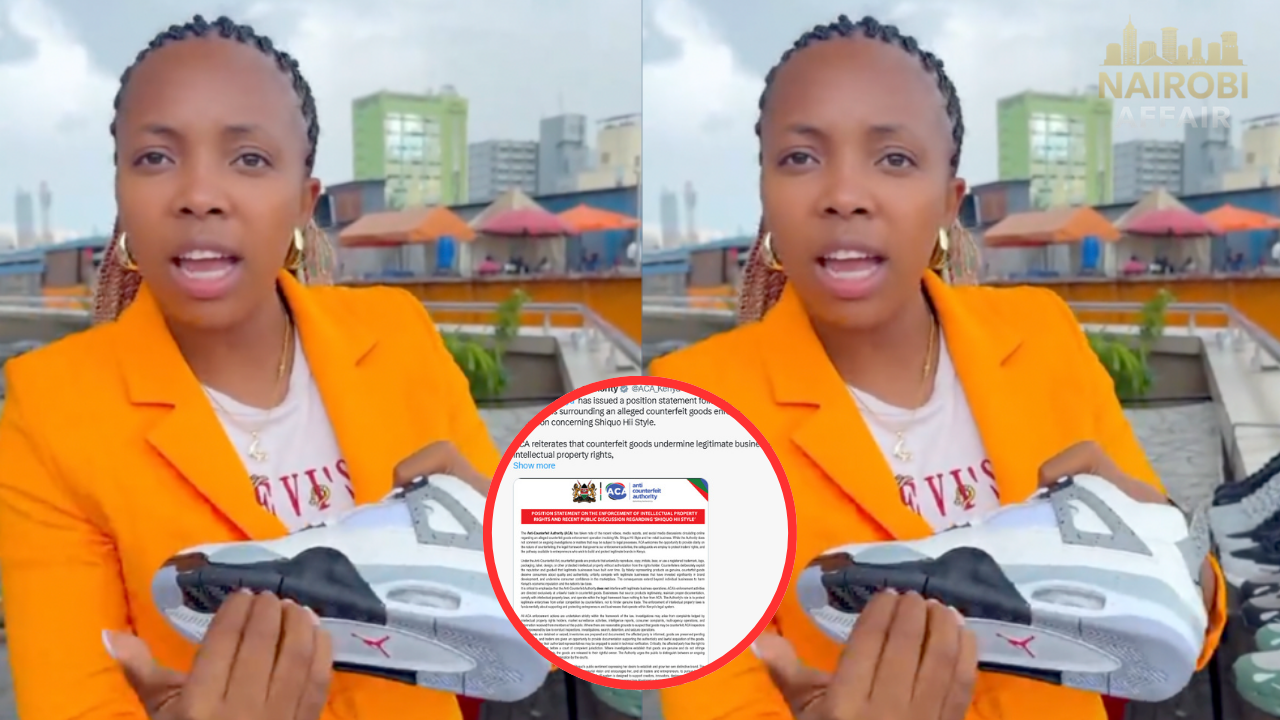
Anti-Counterfeit Authority Breaks Silence on Shiquo Hii Style Raid, Clarifies Counterfeit Goods Enforcement Process
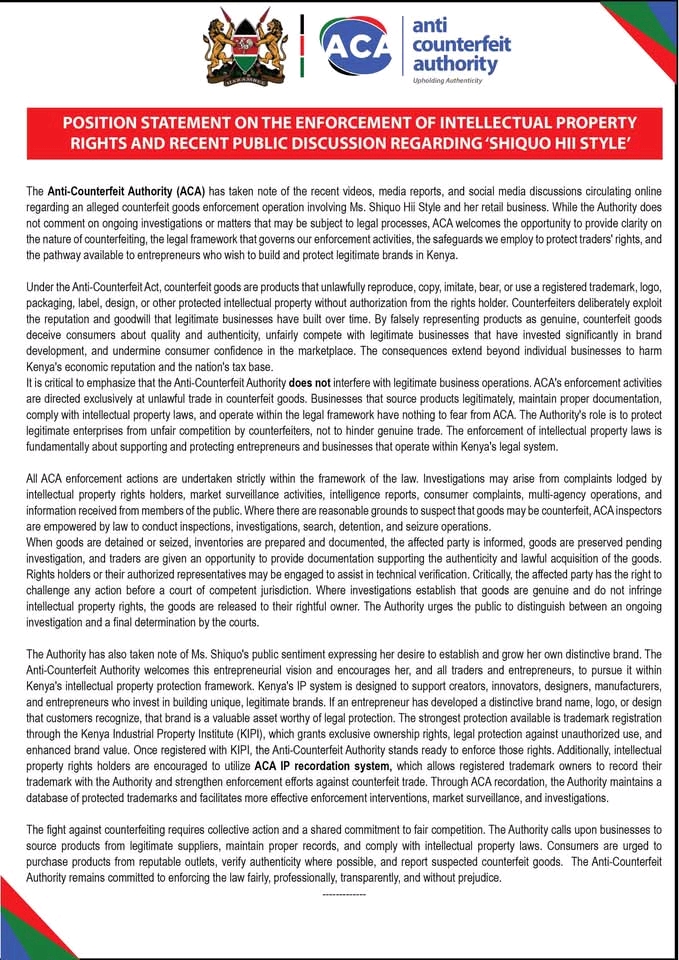
The Anti-Counterfeit Authority (ACA) has issued a detailed position statement following widespread public debate over an enforcement operation involving fashion retailer Shiquo Hii Style, whose business recently became the center of intense discussion on social media.
The statement comes after videos, media reports, and online conversations circulated regarding an alleged counterfeit goods operation targeting the retailer. While the Authority declined to comment on the specifics of the ongoing investigation, it took the opportunity to explain how Kenya’s intellectual property laws work, what constitutes counterfeit goods, and the legal procedures followed during enforcement operations.
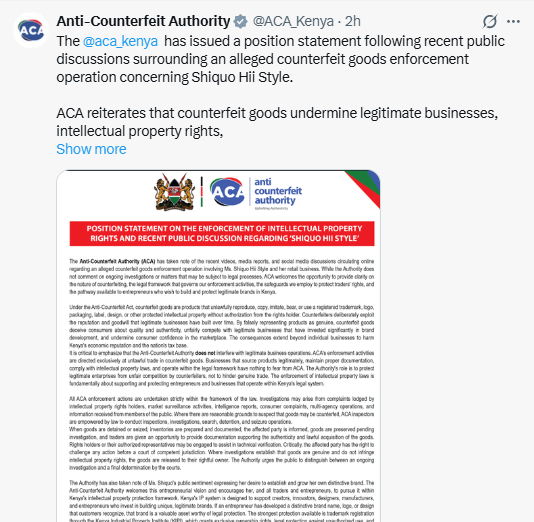
The clarification aims to address growing public interest while reminding both traders and consumers that investigations into suspected counterfeit goods must follow due process and should not be mistaken for a declaration of guilt.
ACA Declines to Discuss Ongoing Investigation
In its statement, ACA noted that it does not publicly discuss active investigations because doing so could interfere with legal processes. Instead, the Authority focused on educating Kenyans about the legal framework governing counterfeit goods and intellectual property rights.

According to ACA, enforcement operations are carried out strictly within the provisions of the Anti-Counterfeit Act and are designed to protect both consumers and legitimate businesses from unfair competition.
The Authority emphasized that while public interest in the Shiquo Hii Style matter is understandable, investigations must be allowed to proceed independently and without undue influence from public opinion.
Seizure of Goods Is Not a Finding of Guilt
One of the key messages in ACA’s statement is that the seizure or detention of goods does not automatically mean a trader has committed an offence.
The Authority explained that enforcement officers may seize goods when there are reasonable grounds to suspect that they could be counterfeit. However, this forms only one stage of the investigative process.
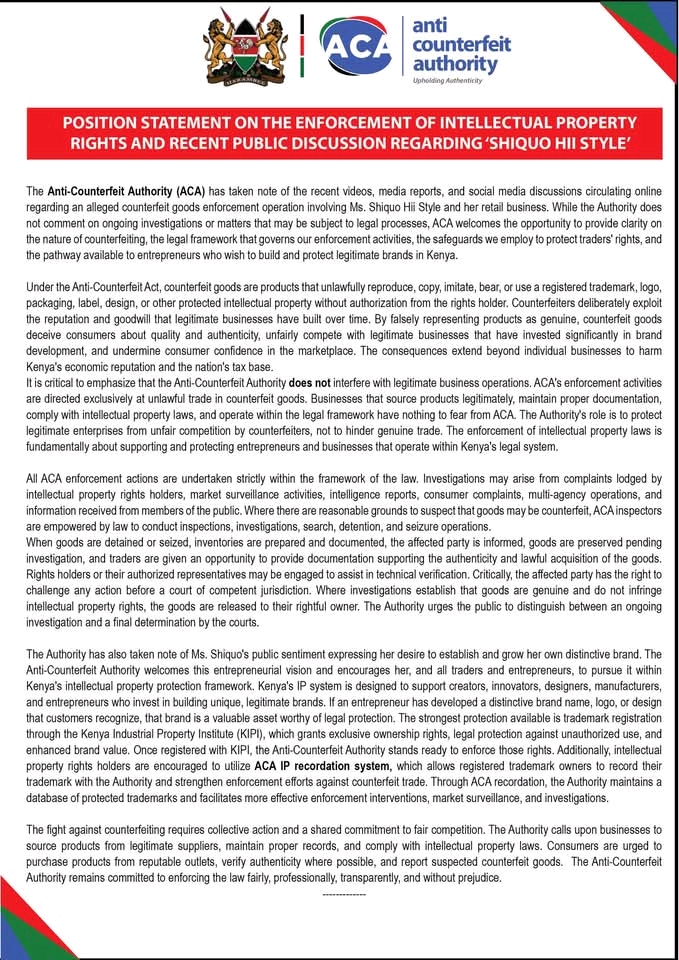
Once goods have been detained, detailed inventories are prepared and preserved as evidence. The affected trader is formally notified and given an opportunity to present documents proving the authenticity and lawful acquisition of the products.
If investigations later establish that the products are genuine and do not infringe intellectual property rights, the goods are released to their rightful owner. Where evidence indicates that the goods violate intellectual property laws, the matter proceeds through the legal process, with the courts making the final determination.
ACA stressed that businesses also have the right to challenge enforcement actions before a competent court if they believe the seizure was unjustified.
This clarification appears intended to reassure traders and the public that enforcement actions are guided by legal safeguards rather than assumptions of wrongdoing.
What Exactly Are Counterfeit Goods?
ACA also used the statement to explain what legally qualifies as counterfeit goods.
According to the Authority, counterfeit products are those that unlawfully reproduce, imitate, or copy another person’s registered trademark, logo, brand name, packaging, design, label, or other protected intellectual property without permission from the rights holder.

Counterfeit goods often resemble genuine products so closely that consumers may struggle to distinguish between authentic and fake items.
The Authority noted that counterfeiters deliberately exploit the reputation and goodwill established by legitimate businesses to deceive consumers into believing they are purchasing genuine products.
While counterfeit clothing and footwear often attract the most public attention, intellectual property infringement affects numerous industries, including electronics, pharmaceuticals, cosmetics, automotive parts, beverages, and household products.
Impact of Counterfeit Trade
ACA warned that counterfeit trade extends far beyond individual businesses.
According to the Authority, the sale of counterfeit products undermines businesses that have invested significant resources in building trusted brands and maintaining quality standards.
Consumers may also suffer financial losses after unknowingly purchasing products that fail to meet expected quality or safety standards.

On a broader scale, counterfeit trade can reduce government tax revenue, discourage innovation, weaken investor confidence, and damage Kenya’s reputation as a destination for legitimate commerce.
The Authority said protecting intellectual property rights is therefore essential not only for brand owners but also for economic growth and fair competition.
ACA Says Legitimate Businesses Have Nothing to Fear
Responding to concerns from traders, ACA stated that its enforcement operations target counterfeit goods—not legitimate businesses.
Businesses that source products legally, maintain proper documentation, comply with intellectual property laws, and cooperate with investigators have nothing to fear from the Authority, the statement said.
ACA explained that enforcement activities are based on intelligence reports, complaints from intellectual property rights holders, market surveillance, information provided by members of the public, and multi-agency operations.
When officers have reasonable grounds to suspect goods may be counterfeit, they are empowered by law to conduct inspections, searches, investigations, and, where necessary, seizures.
However, each case must still undergo legal scrutiny before any conclusion is reached.
Entrepreneurs Encouraged to Build Their Own Brands
The Authority also acknowledged Shiquo Hii Style’s publicly expressed ambition to establish and grow a distinctive fashion brand.
Rather than focusing solely on enforcement, ACA encouraged entrepreneurs to invest in creating original brands protected under Kenya’s intellectual property laws.
The Authority explained that a business’s brand name, logo, product designs, and overall identity can become valuable assets once legally protected.
ACA urged entrepreneurs to register trademarks through the Kenya Industrial Property Institute (KIPI), the government agency responsible for granting exclusive trademark rights in Kenya.
Trademark registration provides legal protection against unauthorized use and enables businesses to build stronger brand recognition while protecting their commercial reputation.
Importance of Intellectual Property Rights Recordation
Beyond trademark registration, ACA encouraged intellectual property owners to utilize its Intellectual Property Rights (IPR) Recordation system.
The Authority explained that IPR Recordation enables trademark owners to officially record their rights with ACA, allowing enforcement officers to more effectively identify counterfeit goods during inspections.
The system also supports investigations by maintaining a database of protected trademarks, making it easier for officers to distinguish legitimate products from suspected counterfeits.
ACA believes greater awareness and use of intellectual property protections will reduce disputes while strengthening Kenya’s fight against counterfeit trade.
Public Urged to Buy Genuine Products
The Authority also appealed directly to consumers.
ACA urged members of the public to purchase products only from reputable suppliers, retain receipts and proof of purchase, and verify product authenticity wherever possible.

Consumers were also encouraged to report suspected counterfeit goods to the Authority to help protect other buyers and support legitimate businesses.
The statement emphasized that consumer awareness remains one of the most effective tools in combating counterfeit trade across the country.
Social Media Debate Continues
The alleged raid on Shiquo Hii Style sparked significant discussion online, with many Kenyans expressing differing opinions about counterfeit enforcement and the challenges faced by small and medium-sized businesses.
Some questioned whether enforcement actions disproportionately affect local traders, while others argued that stronger measures are necessary to protect genuine brands and consumers from counterfeit products.
ACA’s latest statement does not resolve the ongoing investigation but provides important context regarding the legal procedures that govern such operations.
Commitment to Fair Enforcement
Concluding its statement, ACA reaffirmed its commitment to enforcing intellectual property laws fairly, professionally, transparently, and without prejudice.
The Authority reiterated that combating counterfeit goods requires collaboration between government agencies, businesses, intellectual property rights holders, and consumers.
It also encouraged entrepreneurs to view intellectual property protection not merely as a legal requirement but as a valuable investment in the long-term success of their businesses.
As investigations involving Shiquo Hii Style continue, ACA has urged the public to distinguish between an ongoing investigation and a final legal determination, emphasizing that only the courts can ultimately determine liability where offences are alleged.

For now, the Authority says its priority remains protecting consumers, supporting legitimate enterprises, and ensuring that Kenya’s marketplace operates within the law while encouraging innovation, entrepreneurship, and fair competition.


